

Relationships9 min read
Ghosting, Limerence, and Love Bombing: Most of the New Breakup Vocabulary Has Already Peaked
Wikipedia interest in six viral relationship terms since 2016 — four of them, including ghosting and love bombing, already peaked and are now declining. What a decade of pageview data says about the words we use for heartbreak, and what it can't tell you.
 StoriesFly Team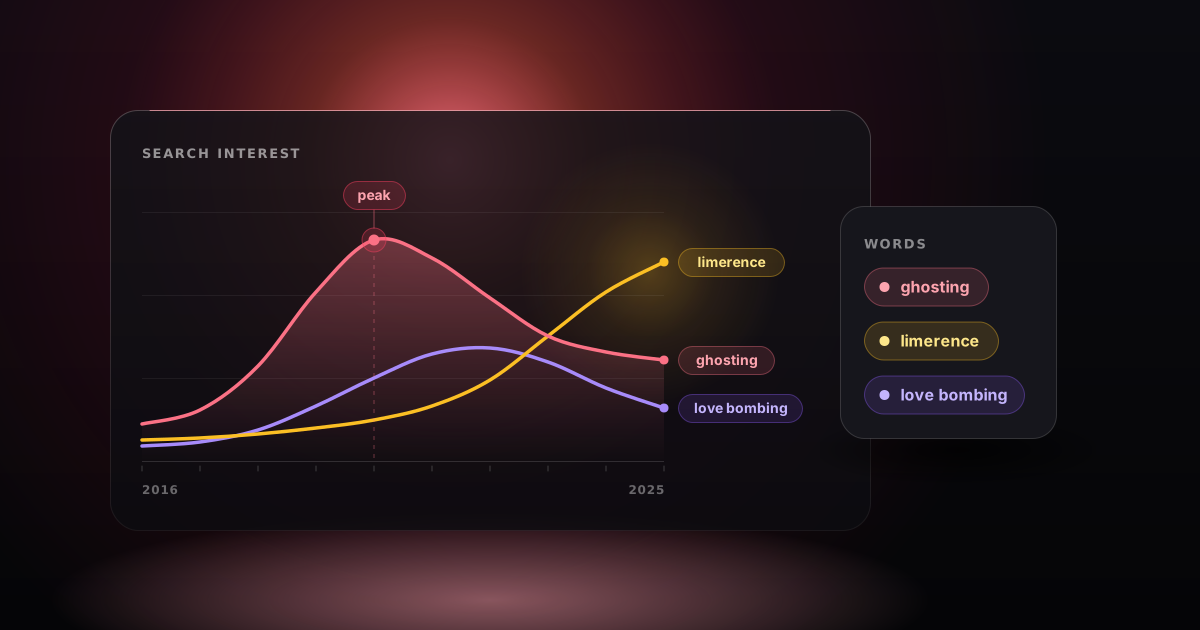
On this page
People ask AI assistants "is ghosting getting more common?" often enough that it deserves a real answer, with a number attached, instead of the usual shrug. Here's the honest one, limitation stated up front instead of buried at the bottom.
What this data can and can't tell you. Everything below comes from how often people read the English Wikipedia article on a term — not from a survey of who actually experienced it. A spike in "Ghosting (behavior)" pageviews means more people looked the word up: a friend used it, a video explained it, a headline mentioned it, a curious person wanted the definition. It does not mean more people ghosted anyone that year. That distinction matters for everything that follows, and we come back to it directly when we get to the actual question people are asking.
The headline number

Interest in "ghosting" on Wikipedia peaked in 2024 and is already down 30% from that peak — even though it's still up 63% since 2021. Limerence tells a similar story at a larger scale: up 159% from 2016 to 2025, but down almost 40% from its own 2024 high. Four of the six newer terms in this dataset have already crested and are declining. Only two — situationship and breadcrumbing — were still climbing as of 2025, the most recent complete year available.
Why we didn't lead with the percent-change number
The obvious stat to reach for is growth from the first year of data to the last, and the raw file behind this piece includes it (change_first_to_last_pct) for exactly the reason it shouldn't be the headline: it's fragile and depends entirely on which year you happen to start counting from. For more details, see our guide on grow followers organically.
Two examples make the case without any argument needed. Breadcrumbing's first-to-last change is +17,993%. Situationship's is +33,462%. Neither number says anything real about how popular either word became — it describes how small the denominator was. Breadcrumbing's Wikipedia article had all of 459 views in its first full year, 2023, because almost nobody had heard of the word yet. Situationship had 90 views in its first full year, 2019. Divide anything by 90 and you get a four-digit percentage; the stat measures the obscurity of a young article's debut year, not the word's trajectory.
That's also why "first year versus last year" is a bad default even for older, stabler terms — you can move the headline just by moving the start date. Limerence "only" rose 159% across 2016–2025, but starting the clock in 2020 instead would produce a much steeper-looking rise to the same 2024 peak. Same underlying data, different number, depending on an arbitrary anchor.
What we used instead is pct_of_peak_now: the most recent full year (2025) as a percentage of the term's own all-time high inside the dataset. It doesn't depend on a start-year choice, only on where the term sits relative to its best year. One caveat is worth stating plainly, though: "peak" here means peak-so-far, inside a window that runs through 2025. A term sitting at 100% of its own peak in 2025 could still be overtaken in 2026 or later — this describes a trajectory inside a fixed window, not a permanent ceiling.
The terms that already peaked
Limerence — the intense, often one-sided infatuation stage of romantic obsession, named by psychologist Dorothy Tennov after interviews with more than 500 people for her 1979 book Love and Limerence — went from 351,634 Wikipedia views in 2016 to a peak of 1,505,374 in 2024, then fell to 910,539 in 2025. That's 60.5% of its peak: far above where it started, but clearly past its high point.
Love bombing peaked earliest of this group, in 2022, at 504,010 views, before settling at 421,478 in 2025 — 83.6% of peak. The term's current pop-therapy use hides a darker origin: it was coined inside the Unification Church in the 1970s to describe the group's own recruitment tactic of overwhelming new members with affection, and was later documented by psychologists studying coercive groups, including Margaret Singer's research on cult recruitment (Singer, 1995, Cults in Our Midst).
Ghosting peaked most recently, in 2024, at 210,630 views, then dropped to 147,087 in 2025 — 69.8% of peak. There is real research behind how people think about the behavior, if not behind the pageview trend itself: Freedman, Powell, Le, and Williams (2019, Journal of Social and Personal Relationships) surveyed several hundred U.S. adults online and found that people who hold "destiny" beliefs about relationships — the idea that you're either meant for someone or you're not — rate ghosting as more acceptable than people who hold "growth" beliefs, where relationships are built rather than found. That's a finding about attitudes toward ghosting. It says nothing about how often ghosting happens, which is exactly the distinction the pageview data can't settle on its own either.
The terms still climbing
Situationship and breadcrumbing are the only two of the six still sitting at their all-time high as of 2025 — pct_of_peak_now is exactly 100% for both. Situationship went from 90 views in 2019 to 30,206 in 2025. Breadcrumbing went from 459 views in 2023 to 83,049 in 2025. Neither has meaningful academic literature behind it yet — they're recent internet coinages, not clinical terms, and it's more honest to say so than to dress them up with a citation that doesn't exist. Whether either has actually peaked, rather than just paused, is something only 2026's full-year number can answer.
The old vocabulary is fading
The flip side of new slang rising is older relationship vocabulary declining, and the dataset shows that just as clearly. Rebound peaked in 2019 at 113,842 views and had fallen to 24,989 by 2025 — 22% of its peak, a 78% drop from the high point. Stalking peaked earliest of anything in the dataset, in 2016, at 487,620 views, and dropped to 159,868 by 2025 — 32.8% of peak. Both words describe things that plainly still happen; what's declining is how often people go looking up the Wikipedia article about them, which is a different fact than the behavior itself declining.
So, is ghosting getting more common?
This is the actual question worth answering directly, since it's the one people bring to a search bar or an AI assistant. The popular assumption is that if you keep hearing a relationship word more, the behavior it names must be increasing too. What the data actually shows is more specific: interest in the word "ghosting" rose sharply through 2024 and has fallen since. That's a fact about attention, not about behavior. A word can get less popular to look up because everyone already knows what it means, because the news cycle around it has moved on, or — just as plausibly — because the underlying behavior really is declining. Wikipedia pageviews can't distinguish between those explanations, and no single search-interest dataset can. The honest answer is: the word's popularity has already crested. Whether people are ghosting each other more or less than they were in 2024 is not something this data — or any pageview chart — can tell you on its own.
Method
Source: Wikimedia REST Pageviews API, English Wikipedia, all-access traffic with bots excluded by the API itself. License: CC0-1.0. Each term's yearly_views figure is the sum of that article's monthly pageviews for the calendar year. first_full_year and last_full_year mark the article's earliest and latest complete calendar years inside the collection window (July 2015 to July 2026). peak_year and pct_of_peak_now compare the most recent full year against the single highest year on record. change_first_to_last_pct is included in the raw data, and in this piece specifically, to show why it's an unreliable headline stat whenever either endpoint year has a small base — see the breadcrumbing and situationship figures above.
To reproduce: pull relationship-vocabulary.json directly — it contains the same yearly figures used here, one object per term, plus the derived stats. For month-by-month seasonal patterns in related search terms — a different question from the year-over-year trend covered here — see relationship-seasonality.json and relationship-seasonality.csv.
This piece is part of a research series on storiesfly.com auditing commonly cited relationship statistics for sourcing.
FAQ
Is ghosting becoming more common?
Wikipedia interest in the word "ghosting" rose from 2021 through a 2024 peak and has fallen 30% since. That measures how often people looked up the term, not how often the behavior happens — the two can move independently, and this dataset can't tell you which way actual ghosting behavior is trending.
Which relationship term grew the most on Wikipedia?
By raw percentage change, situationship and breadcrumbing show the largest growth, but those figures are inflated by tiny starting-year view counts. Measured against each term's own peak year instead, love bombing (452% from 2016 to 2025) and limerence (159%) show the most durable long-term growth.
Have any of these terms already peaked?
Four of six have: limerence and ghosting in 2024, love bombing in 2022, and stalking all the way back in 2016 (rebound peaked in 2019). Only situationship and breadcrumbing were still at their all-time high as of 2025, the most recent full year in the data.
Why not just use the percentage change from the first year to the last year?
Because it's driven by whatever the first year happens to be. A term with a tiny first-year view count, like breadcrumbing or situationship, produces a percentage in the tens of thousands that describes the smallness of the starting point rather than the word's real trajectory. Comparing the latest full year to the term's own peak year avoids that distortion, with one caveat: it can only report the peak observed so far, not a permanent one.