

I Accidentally Viewed My Ex's Story — Does It Break No Contact?
Short answer: no. What breaks no contact, what an accidental story view actually means, and how to stop the 'accidents' from becoming a habit again.
StoriesFly Team
It's 11 PM, you're flicking through stories on autopilot, and suddenly their face is on your screen. You tap away in a panic — too late. Your name is now on their viewer list, and you're lying in the dark wondering if you just reset forty days of no contact to zero.
Short answer, and you can exhale now: no, an accidental story view does not break no contact. Here's the longer answer, because the guilt spiral you're in right now is worth taking apart properly. For more details, see our guide on view stories anonymously. For more details, see our guide on how long Instagram stories last.
What No Contact Actually Is
No contact is a boundary about communication and pursuit, not about information existing in the world. It means: no texting, no calling, no DMs, no "accidental" run-ins you engineered, no replying when they reach out (unless you share kids, property or a workplace — that's low contact, a different protocol). The point of the rule is to stop feeding the attachment system fresh interaction, so it can start to quiet down.
Watching a story is none of those things. You didn't speak to them. You didn't signal availability. You didn't invite them back in. Their phone showed them a username on a list — information *about you* reached them, but no contact happened. A therapist would file this under "monitoring," not "contact," and monitoring is a habit problem, not a boundary violation.
So no — the streak, in any meaningful sense, is intact.
Why It Still Feels Like a Relapse
Because part of it was one. Be honest with the sequence: the tap might have been an accident, but being *in a position* to tap — hovering near their orbit at 11 PM — often isn't. Most "accidental" views cluster at the exact hours when checking used to be a ritual: late night, first thing in the morning, mid-scroll boredom. The muscle memory survived the breakup even if the relationship didn't.
That's the part worth your attention. Not the viewer list. Nobody's healing has ever been undone by appearing on a viewer list — but plenty of healing gets undone by what usually follows the "accident": the full profile visit, the highlight rewatch, the zoom on who's in the photo. One breakup-recovery survey puts the share of people who monitor an ex online at 88%, and the research consistently points the same way — people who keep monitoring take dramatically longer to recover (a commonly cited study says around 60% longer).
The accidental view is noise. The checking habit underneath it is the signal.
Will They Think It Means Something?
Maybe. You can't control that, and trying to manage their interpretation is itself a form of contact-seeking — you'd be acting *for their eyes* again. Do not send the "sorry, accidental view lol" text. That breaks no contact for real, converts a nothing-event into an opening, and tells them you're tracking how you appear to them.
For what it's worth: people check their own viewer lists far less obsessively than viewers assume, and a single view reads as exactly what it was — a stray tap. It carries no message unless you follow it with one.
Resetting the Counter Is a Trap
Here's where a lot of no-contact culture quietly hurts people. If you treat day counts as sacred and a stray story view as day zero, you've built a system where one twitch of a thumb erases six weeks of real progress. Brains under that rule do a predictable thing: "well, the streak's dead anyway" — and then comes the real relapse, the two-hour deep scroll.
Count it differently. Your streak measures days without seeking them out. An accidental view doesn't zero it; a deliberate hunt does. And even then — a relapse with a 40-day record behind it is not the same as never having stopped. The record stands. "My best is 40 days" is a fact no bad night deletes.
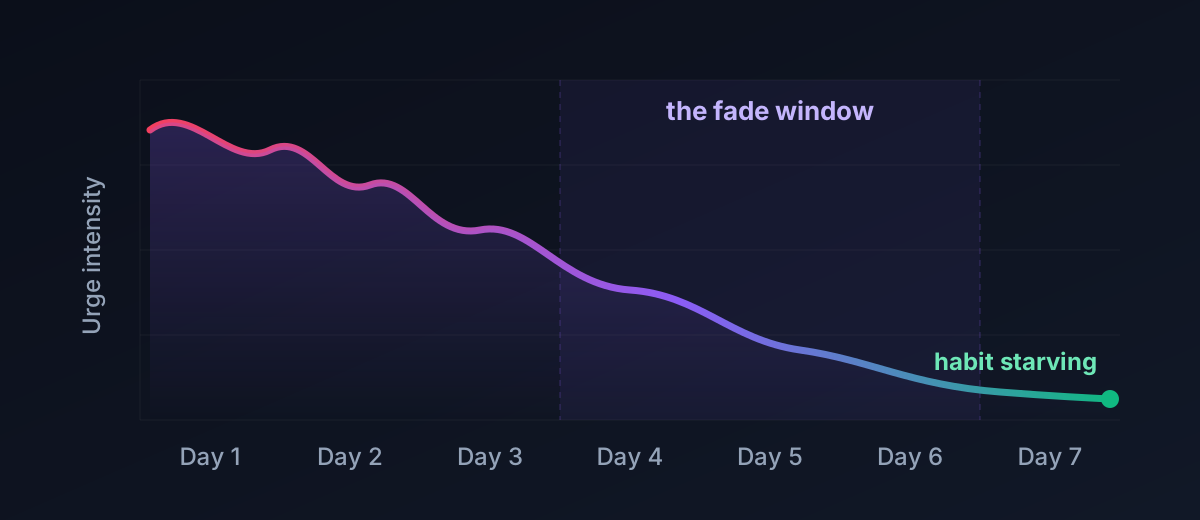
People who quit the checking habit describe the same curve: brutal for a few days, a noticeable fade around days 4–6, and something like indifference after a week or two. Every day you don't feed the loop, the next urge arrives a little weaker. That's the curve an accidental view cannot touch — only deliberate checking restarts it.
How to Stop the "Accidents"
Related tools
The goal isn't punishing yourself for the last slip; it's making the next one structurally harder.
- 1Mute them everywhere. Their stories and posts, muted — they'll never know, and the algorithm stops ambushing you. On Instagram: their profile → Following → Mute → both toggles.
- 1Starve the suggestion engine. Unfollow if muting isn't enough. If seeing mutual friends' tags keeps pulling you back, mute the mutuals for a month too. Nothing personal; it's triage.
- 1Give the urge a delay, not a debate. When the pull hits, don't argue with it — schedule it. Five minutes. Most urges are spikes that collapse before the timer does. (This is the technique Psychology Today recommends for exactly this habit.)
- 1Lock the profile where you check it. If your checking runs through anonymous viewers — and if you're reading this, it might — we built a free tool for precisely this failure mode: Detox Mode lets you lock one specific profile, and from then on it shows *you* no stories at all, just a counter of days since you stopped looking. The ritual can continue; the payoff is gone, and habits don't survive long without payoff. It also comes with the urge timer and a 7-day streak challenge, free, in the browser. One honest caveat: the lock works inside StoriesFly only — Instagram itself is what the mute button is for.
- 1Handle the 2 AM problem specifically. Phone charges outside the bedroom, or Instagram gets a Screen Time limit after 11 PM. Almost every "accident" has the same timestamp; remove the timestamp.
When It's More Than a Slip
If checking eats hours of your day, wrecks your sleep, or comes with distress you can't down-regulate, that's not a viewer-list problem or a willpower problem — it's the point where a therapist beats any tool or article. Going is the strong move.
FAQ
Does viewing an Instagram story count as breaking no contact?
No. No contact is about communication and pursuit — texting, calling, DMs, engineered run-ins. A story view sends no message and opens no channel. It's monitoring, which is a habit worth breaking for your own sake, but it doesn't violate the boundary or "reset" your progress.
Should I apologize or explain the accidental view?
No. Sending "sorry, that was an accident" is actual contact — it breaks the boundary for real, and it signals that you're monitoring how you appear to them. Let a stray view stay what it is: nothing.
Can I watch their stories anonymously instead?
You can, but be honest about what that solves: it hides your name from the viewer list, not the habit from your brain. Anonymous checking feeds the exact same loop and carries the same recovery cost. If you keep reaching for an anonymous viewer to check one specific person, that's the signal to try locking that profile instead.
How long until I stop wanting to check?
Most people describe days 1–3 as the hardest, a clear fade around days 4–6, and near-indifference after a couple of weeks of genuinely not checking. The curve only resets when you feed it — deliberate checking restarts the loop; an accidental view doesn't.
Do they know if I look at their profile, without viewing a story?
Profile visits, photo views and scrolling leave no trace on Instagram — viewer lists exist only for stories (and live videos). But "they can't see me" is a reason your brain uses to keep the habit alive, not a reason the habit is harmless.